Network Seminar Series – November 2025
Societal Perspectives and Prioritisation of AMR interventions
The IMPACT AMR Network take a transdisciplinary approach to improving the use of evidence to inform prioritisation of efforts to impact antimicrobial resistance. In Autumn 2025, we will be running a series of thematic seminars, inviting 2-3 speakers at each event to present their work and to engage with the Network’s members to discuss findings, approaches and ways forward.
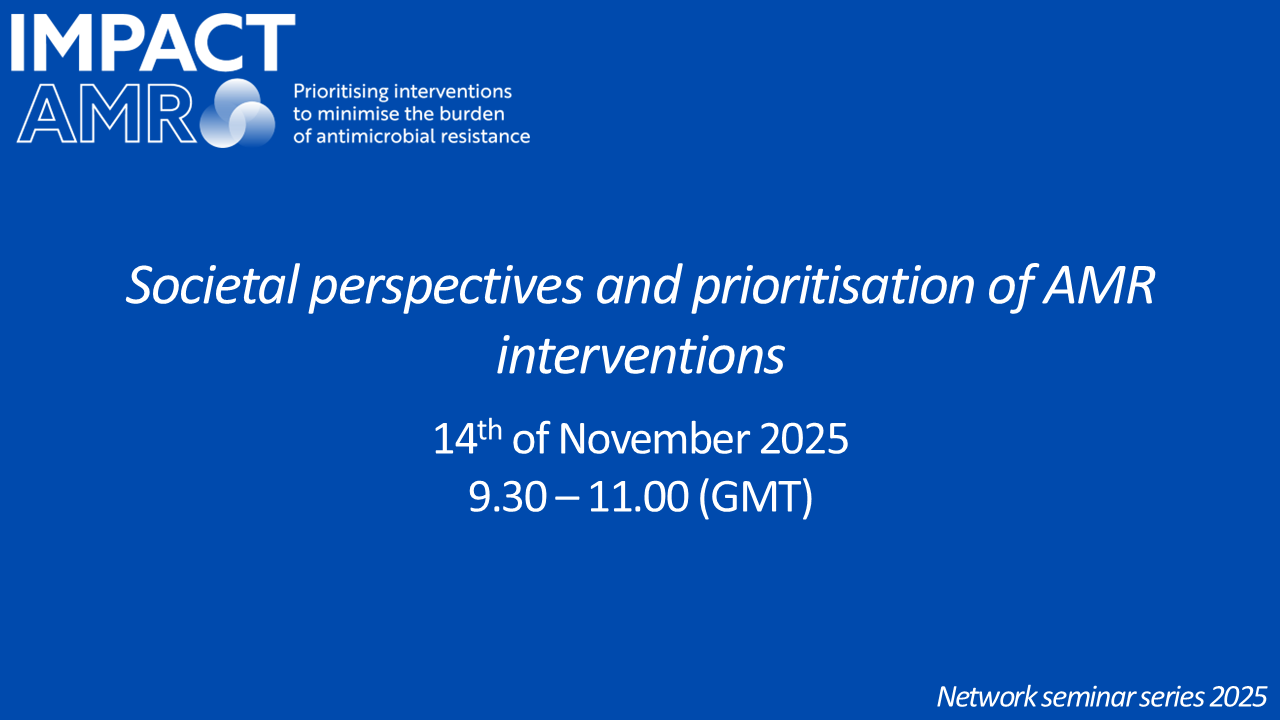
The third seminar of the series, ‘Societal Perspectives and Prioritisation of AMR Interventions’ will take place on the 14th of November 2025, from 9.30 to 11.00 (GMT), via Zoom, with speakers presenting perspectives from experts, patients and citizens.
Presentations and discussions will include:
- ‘Expected economic losses and return on investment from AMR interventions’ by Dr Chantal Morel
- ‘Chronic living with AMR infections’ by Professor Andrea Whittaker
- ‘Understanding citizens’ priorities for interventions to mitigate antibiotic resistance; the role of Deliberative Polling’ by Professor Marc Mendelson
Invited Speakers
Dr. Chantal Morel – University Hospital Bonn
Dr Morel is a health economist with over 20 years of experience in economic issues related to antimicrobial resistance (AMR). Her research examines the costs associated with AMR and the use of interventions to reduce the overall economic burden. This includes interventions for prevention and at the point of prescribing in both human and animal settings. It also looks at the use of new financing and structural arrangements to bolster innovation in the pipeline to produce better products, improve surveillance of resistance, broaden system-wide sustainable use measures, and increase access to antimicrobials where there is clinical need currently unmet by supply. Morel has also supported the implementation of numerous monitoring and evaluation systems for large NGOs tackling infectious diseases in Asia and Africa.
Prof. Andrea Whittaker – Monash University
Andrea Whittaker PhD, FASSA is Professor of Anthropology at the School of Social Sciences, Monash University, Melbourne, Australia. She is a medical anthropologist and a Lead Researcher with the Centre to Impact AMR. Her work includes research on reproductive health and biotechnologies as well as social aspects of AMR.
Prof. Marc Mendelson – University of Cape Town
Prof Mendelson has worked in South Africa for two and a half decades, before which he worked and studied in the UK and US. His long standing work on AMR includes starting the National Antimicrobial Stewardship Training Centre in 2014, being the founding co-chair of the South African Antibiotic Stewardship Programme and chairing the Ministerial Advisory Committee on Antimicrobial Resistance since 2014. His focus is on national and international policy in relation to Antimicrobial Resistance and is on the WHO’s Expert Advisory Panel on Drug Evaluation and multiple Technical Advisory Groups on AMR internationally.
Key Readings
AMR survivors? Chronic living with antimicrobial resistant infections
Deliberative Polling on Antimicrobial Resistance with Stanford University – The Trinity Challenge