Network Seminar Series – December 2025
Equity in AMR Action
The IMPACT AMR Network take a transdisciplinary approach to improving the use of evidence to inform prioritisation of efforts to impact antimicrobial resistance. In Autumn 2025, we will be running a series of thematic seminars, inviting 2-3 speakers at each event to present their work and to engage with the Network’s members to discuss findings, approaches and ways forward.
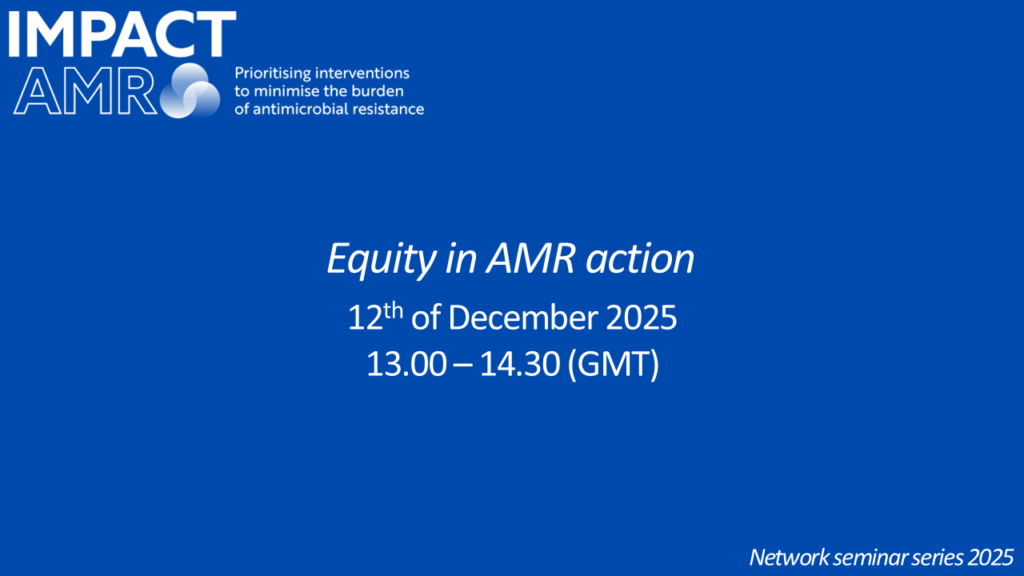
The fourth seminar of the series, ‘Equity in AMR Action’, will take place on the 12th of December 2025, from 13.00 to 14.30 (GMT), via Zoom, focusing on the work done by experts for the World Health Organisation, by the London School of Economics, and the Global Strategy Lab.
Presentations and discussions will include:
- The latest WHO report on equity dimensions of AMR.
- The development of an AMR accountability index to benchmark and measure national performance in tackling AMR. The development of the index is ongoing, based on robust evidence synthesis and consensus-building methodologies.
- The AMR Policy Accelerator at York University’s Global Strategy Lab has developed the Smart Choice Process to prioritise AMR interventions systematically and transparently as part of the policy-responsiveness research to achieve stronger national action plan (NAP) implementation. The team have supported multiple countries with support to update AMR NAPs using the Smart Choice Process, based on context-specific priorities.
Invited Speakers
Victoria Saint – Bielefeld University
Victoria Saint is a global public health researcher and policy analyst specialising in health equity and the social determinants of health (SDH). She joined the School of Public Health at Bielefeld University, Germany as a research associate in 2019. Her doctoral research focuses on the equity, SDH and gender dimensions of antimicrobial resistance (AMR). Victoria works as a consultant for the International Centre for Antimicrobial Resistance Solutions (ICARS) and was a consultant with the AMR Division of WHO headquarters in 2024/25. Prior to joining Bielefeld University, Victoria worked as a Technical Officer and consultant for WHO, and in various consultancy and staff positions with other UN and academic organisations.
Dr. Michael Anderson – The University of Manchester and visiting fellow of The London School of Economics and Political Science
Dr Michael Anderson is a National Institute for Health Research (NIHR)-funded Clinical Lecturer in Primary Care at the University of Manchester, Visiting Fellow at the London School of Economics and Political Science, and a General Practitioner. His broad research interests are focused on health economics, with a specific focus on antimicrobial resistance (AMR) and pharmaceutical policy, public–private health sector dynamics, health workforce strategy, disinvestment from low-value care, and international comparative health system performance. He was co-research lead for the LSE–Lancet Commission on the Future of the NHS, lead author of the 2022 UK Health System in Transition Report, and has served as a technical advisor on AMR and health systems for the World Health Organization (WHO), including during the 2019 Romanian, 2023 Swedish, and 2024 Belgian EU Council Presidencies. He is also a Senior Expert Advisor to the European Observatory on Health Systems and Policies. Michael’s work on AMR spans national and global levels, including developing accountability frameworks, advising on National Action Plans, and examining financial and regulatory incentives to align public health goals with pharmaceutical innovation and stewardship.
Dr Emily O’Neill – The London School of Economics and Political Science
Emily O’Neill is a health services researcher working on the development of the Antimicrobial Resistance(AMR) Accountability Index. Emily completed her PhD at Brown University, where she worked as a Research Associate, conducting research in pharmacoepidemiology, health economics, and quantitative evaluations of AMR policies. During her PhD, she continued clinical practice within an academic medical centre as an infectious disease (ID) pharmacist. She has over seven years of clinical experience in ID and antimicrobial stewardship. Her research goals are to bridge the gap between clinical insights and research methodologies, facilitating their translation into actions that promote responsible antimicrobial use.
Dr Kadia Petricca – The Global Strategy Lab
Kadia Petricca is the Senior Policy Lead at the Global Strategy Lab’s AMR Policy Accelerator, where she leverages her expertise in global health policy and implementation science to lead the Smart Choice Process portfolio with partner countries. She is dedicated to strengthening evidence-to-policy translation and has extensive experience facilitating multisectoral policy dialogues and producing knowledge products to inform decision-making. She holds an MSc in Public Health in Developing Countries from the London School of Hygiene and Tropical Medicine and a PhD in Global Health Policy from the University of Toronto.
Key Readings
Mapping socioeconomic factors driving antimicrobial resistance in humans: An umbrella review
These papers scope out multiple dimensions of AMR that are exacerbated by social and economic factors in different contexts, showing the need for consideration of inequalities in the prioritisation of interventions.
With WHO EURO, the team propose the development of an AMR accountability index to benchmark and measure national performance in tackling AMR. The development of the index is ongoing, based on robust evidence synthesis and consensus-building methodologies.
The AMR Policy Accelerator at York University’s Global Strategy Lab has developed the Smart Choice Process to prioritisize AMR interventions systematically and transparently as part of policy-responsive research to achieve stronger national action plan (NAP) implementation. The team have supported multiple countries with support to update AMR NAPs using the Smart Choice Process, based on context-specific priorities.